
Margaret Hamilton, Who Helped Put Humans on the Moon, Has Died
Margaret Hamilton led the Apollo software team that helped land humans on the Moon and championed software engineering as a discipline built around reliability and resilience.
The alarm that didn't stop the landing
It is July 1969. The Apollo 11 lunar module is minutes from touching down, and the onboard computer starts flashing an alarm: 1202. The machine is overloaded, thanks to a problem with a hardware switch, and nobody is sure it can handle the most delicate maneuver of the mission.
In another era, that might have been the end of the landing. It wasn't, because years earlier a team of MIT software engineers had built the computer to expect trouble. Its software was priority-driven: when it was swamped, it dropped the less important jobs and held on to the ones that mattered. Mission control understood what the alarm meant, trusted the software, and told the crew to keep going. Two people walked on the moon.
The woman who led that software effort was Margaret Hamilton. She died on September 30, 2026, at the age of 90, MIT announced this week.
From weather forecasts to the moon
Hamilton was born in Paoli, Indiana, in 1936. She studied mathematics, finishing a degree at Earlham College in 1958 with a minor in philosophy, and moved to Boston the following year when her husband began law school. She expected the job at MIT to be temporary. It was a position in the meteorology department, writing weather-prediction software for Edward Lorenz, whose later work on chaos theory her programming helped inform.
From there she moved to MIT Lincoln Laboratory to work on SAGE, the country's first air defense system. That is where she grew fascinated by something almost no one was talking about yet: how to make software reliable.
In 1965, just as she was planning graduate school, her husband spotted a newspaper ad. MIT's Instrumentation Lab needed people to write the flight software that would send a man to the moon. Hamilton applied and became the first programmer hired for Apollo at MIT. By 1968 she was an assistant director running the team behind the Command and Service Module software, part of an effort that involved more than 400 people.
The error her daughter found
One of the most beloved stories about Hamilton's career starts with her four-year-old daughter, Lauren, playing in the command module simulator at the lab. Lauren accidentally launched a pre-launch program in the middle of a simulated flight, and the simulator crashed.
Hamilton saw the risk right away. She wrote a warning into the documentation and proposed a software safeguard, but she was overruled: astronauts were far too well trained to make that mistake. Then, on Apollo 8 in 1968, Jim Lovell did exactly that, wiping out navigation data in flight. Hamilton's team got it sorted out, and her safeguard went into the software.
The lesson is one engineers still carry: build systems that anticipate mistakes and recover from them, rather than assuming people and machines will always behave. Today we call it defensive programming.
Giving software its due
Hamilton didn't stop at Apollo. When the Instrumentation Lab became the independent Draper Laboratory, she kept going, founding Higher Order Software in 1976 and, about ten years later, Hamilton Technologies. Both were built around her conviction that errors should be prevented by design, not caught after the fact. Her company's Universal Systems Language grew out of that philosophy.
She also fought for the idea that software deserved to be treated as a real engineering discipline. By her own account, when she began using the phrase "software engineering," people thought it was a joke. Over a career that produced more than 130 publications, the joke turned into an industry.
The recognition eventually arrived:
NASA's Exceptional Space Act Award (2003)
The Presidential Medal of Freedom, presented by President Obama (2016)
Computer History Museum Fellow (2017)
The Intrepid Lifetime Achievement Award (2019)
Induction into the National Aviation Hall of Fame (2022)
An icon for a new generation
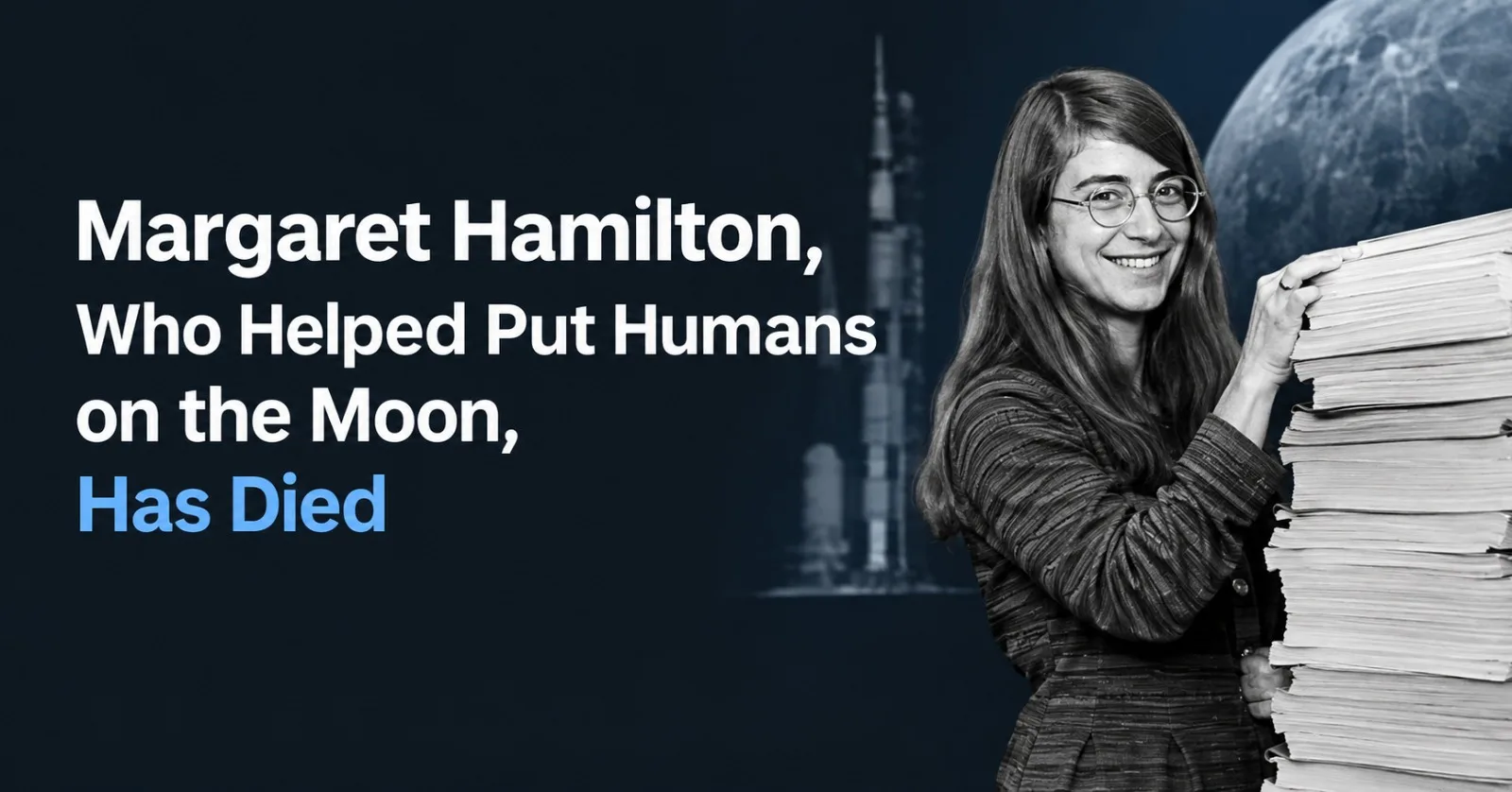
For many people, Hamilton became familiar through a single photograph: a young woman standing beside a stack of Apollo code printouts about as tall as she is. As that image spread online, she became a symbol for women in science and technology. In 2015 the Apollo software was uploaded in full to GitHub, and in 2017 she became a Lego minifigure in the Women of NASA set designed by MIT's Maia Weinstock.
Looking back on her Apollo years, Hamilton said there was "no choice but to be pioneers." She was right about the pioneering, though the choice she made was her own: to take a field everyone treated as a mystery and a black box, and insist that it be done carefully, honestly, and with respect for the people who would depend on it.
Every time software quietly handles a failure so you never notice, there's a bit of her work in it.
Hamilton is survived by her daughter, Lauren Hamilton, her son-in-law, two grandsons, four great-grandchildren, and her siblings. A memorial service is planned for the spring in Cambridge, Massachusetts.
Published via ZyVOP — Write once in Markdown, auto-backup to GitHub, and syndicate to Dev.to, Medium & Hashnode in 1 click.