


Bookmark this page. It covers the syntax you'll use most, with short examples and diagrams for the parts people forget. Examples use PostgreSQL syntax; a dialect table near the end lists where MySQL and SQL Server differ.

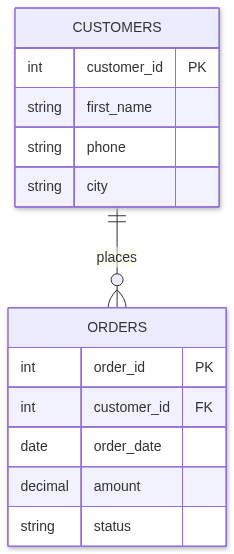
The examples use these two tables:
1. Query Anatomy
SELECT   c.city, COUNT(*) AS order_count              -- what to return
FROM     customers c                                  -- where it comes from
JOIN     orders o ON o.customer_id = c.customer_id    -- combine tables
WHERE    o.status = 'completed'                       -- filter rows
GROUP BY c.city                                       -- build groups
HAVING   COUNT(*) > 5                                 -- filter groups
ORDER BY order_count DESC                             -- sort
LIMIT    10 OFFSET 20;                                -- paginate
Add DISTINCT after SELECT to remove duplicate result rows. You write SELECT first, but SQL processes the query in the logical order below, which is why most databases reject aliases and aggregates in WHERE:

2. Filtering with WHERE
| Operator | Example | Meaning |
|---|---|---|
| =, <> | status = 'completed' | Equal, not equal (!= also works in most databases) |
| <, <=, >, >= | amount >= 100 | Comparison |
| BETWEEN | amount BETWEEN 10 AND 50 | Inclusive on both ends |
| IN | city IN ('Paris', 'Rome') | Matches any value in the list |
| LIKE | first_name LIKE 'A%' | % = any characters, _ = one character |
| IS NULL | phone IS NULL | Missing value (never use = NULL) |
| AND, OR, NOT | (a OR b) AND c | Combine conditions; use parentheses |
3. Aggregates and Grouping
| Function | Returns | NULLs |
|---|---|---|
| COUNT(*) | Number of rows | Counted |
| COUNT(col) | Number of non-NULL values | Skipped |
| COUNT(DISTINCT col) | Number of unique non-NULL values | Skipped |
| SUM, AVG, MIN, MAX | Total, mean, smallest, largest | Skipped |
SELECT customer_id, COUNT(*) AS order_count, SUM(amount) AS total
FROM orders
WHERE status = 'completed'       -- filters rows before grouping
GROUP BY customer_id
HAVING SUM(amount) > 1000        -- filters groups after aggregating
ORDER BY total DESC;
Rule: every non-aggregated column in SELECT must be listed in GROUP BY.
4. Joins
SELECT c.first_name, o.amount
FROM customers c
LEFT JOIN orders o ON o.customer_id = c.customer_id;
| Join | Keeps |
|---|---|
| INNER JOIN | Only rows that match in both tables |
| LEFT JOIN | All left rows, plus matches from the right (NULL if none) |
| RIGHT JOIN | All right rows, plus matches from the left |
| FULL JOIN | All rows from both tables |
| CROSS JOIN | Every left row paired with every right row |
Joining Table A (ids 1, 2, 3) with Table B (ids 2, 3, 4) on id:
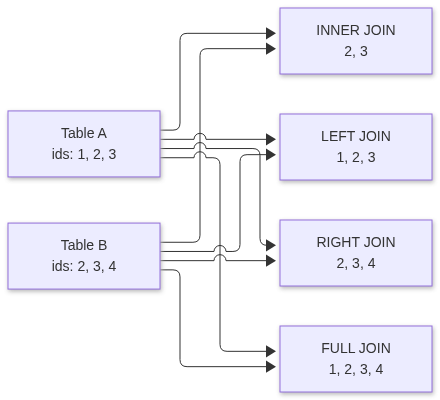
Tip: to filter the right table of a LEFT JOIN, put the condition in ON, not WHERE; a WHERE condition on right-side columns silently turns it into an inner join. The one exception is WHERE o.order_id IS NULL, which finds left rows with no match.
5. Common Functions
| Type | Functions |
|---|---|
| Text | UPPER(s), LOWER(s), TRIM(s), LENGTH(s), SUBSTRING(s, start, len), REPLACE(s, from, to), CONCAT(a, b) |
| Numeric | ROUND(x, n), CEIL(x) / CEILING(x), FLOOR(x), ABS(x), MOD(x, y) or x % y |
| NULL handling | COALESCE(a, b, ...) first non-NULL; NULLIF(a, b) returns NULL if equal |
| Dates | CURRENT_DATE, CURRENT_TIMESTAMP, EXTRACT(YEAR FROM d), DATE_TRUNC('month', d) (date functions vary a lot; see the dialect table) |
| Conversion | CAST(x AS type) (PostgreSQL also accepts x::type) |
CASE expression
SELECT order_id,
       CASE WHEN amount >= 500 THEN 'large'
            WHEN amount >= 100 THEN 'medium'
            ELSE 'small'
       END AS order_size
FROM orders;
6. Subqueries, CTEs, and Set Operations
-- CTE: a named, reusable subquery
WITH big_spenders AS (
    SELECT customer_id, SUM(amount) AS total
    FROM orders
    GROUP BY customer_id
    HAVING SUM(amount) > 1000
)
SELECT c.first_name, b.total
FROM big_spenders b
JOIN customers c ON c.customer_id = b.customer_id;

-- EXISTS: does a related row exist?
SELECT first_name
FROM customers c
WHERE EXISTS (SELECT 1 FROM orders o WHERE o.customer_id = c.customer_id);

-- Prefer NOT EXISTS over NOT IN when the subquery can return NULL
SELECT first_name
FROM customers c
WHERE NOT EXISTS (SELECT 1 FROM orders o WHERE o.customer_id = c.customer_id);
| Operator | Result |
|---|---|
| UNION | Rows from both queries, duplicates removed |
| UNION ALL | Rows from both queries, duplicates kept (faster) |
| INTERSECT | Rows that appear in both |
| EXCEPT | Rows in the first but not the second (MINUS in Oracle) |
Both queries need the same number of columns with compatible types. (MySQL supports INTERSECT and EXCEPT from version 8.0.31.)
7. Window Functions
Window functions calculate across related rows without collapsing them into one row.
SELECT order_id, customer_id, amount,
       ROW_NUMBER() OVER (PARTITION BY customer_id ORDER BY order_date DESC) AS rn,
       LAG(amount)  OVER (PARTITION BY customer_id ORDER BY order_date)      AS prev_amount,
       SUM(amount)  OVER (PARTITION BY customer_id ORDER BY order_date
                          ROWS BETWEEN UNBOUNDED PRECEDING AND CURRENT ROW)  AS running_total
FROM orders;
PARTITION BY splits rows into groups, ORDER BY orders rows inside each group. Here's how the ranking functions treat ties, for scores 100, 100, 90:
| Score | ROW_NUMBER() | RANK() | DENSE_RANK() |
|---|---|---|---|
| 100 | 1 | 1 | 1 |
| 100 | 2 | 1 | 1 |
| 90 | 3 | 3 | 2 |
Other useful ones: LEAD() (next row), NTILE(n) (split into n buckets), FIRST_VALUE().
You can't filter on a window function in WHERE. To keep only rn = 1, wrap the query in a CTE or subquery first.
8. Changing Data
INSERT INTO customers (first_name, city) VALUES ('Anna', 'London');   -- assumes customer_id auto-generates

UPDATE orders SET status = 'cancelled' WHERE order_id = 1042;

DELETE FROM orders WHERE order_id = 1042;

-- Upsert (PostgreSQL)
INSERT INTO customers (customer_id, first_name) VALUES (1, 'Anna')
ON CONFLICT (customer_id) DO UPDATE SET first_name = EXCLUDED.first_name;
Always include
WHEREonUPDATEandDELETE. Without it, every row is changed. Test the filter with aSELECTfirst.
Transactions
BEGIN;       -- START TRANSACTION in MySQL, BEGIN TRANSACTION in SQL Server
UPDATE accounts SET balance = balance - 100 WHERE id = 1;
UPDATE accounts SET balance = balance + 100 WHERE id = 2;
COMMIT;      -- or ROLLBACK; to undo everything since BEGIN
9. Defining Structure
CREATE TABLE orders (
    order_id    INT PRIMARY KEY,
    customer_id INT NOT NULL,
    order_date  DATE NOT NULL DEFAULT CURRENT_DATE,
    amount      DECIMAL(10,2) CHECK (amount >= 0),
    status      VARCHAR(20),
    FOREIGN KEY (customer_id) REFERENCES customers (customer_id)
);

ALTER TABLE orders ADD COLUMN notes TEXT;
ALTER TABLE orders DROP COLUMN notes;
CREATE INDEX idx_orders_customer ON orders (customer_id);
TRUNCATE TABLE orders;    -- destructive: deletes all rows, keeps the table
DROP TABLE orders;        -- destructive: deletes the table itself
| Type | Use for |
|---|---|
| INT, BIGINT | Whole numbers, IDs |
| DECIMAL(p, s) | Money and exact numbers (avoid FLOAT for money) |
| VARCHAR(n), TEXT | Text |
| DATE, TIMESTAMP | Dates and date-times |
| BOOLEAN | True / false (BIT in SQL Server) |
10. Dialect Differences
| Task | PostgreSQL | MySQL | SQL Server |
|---|---|---|---|
| Limit rows | LIMIT 10 | LIMIT 10 | SELECT TOP 10 or OFFSET ... FETCH |
| Current date | CURRENT_DATE | CURRENT_DATE | CAST(GETDATE() AS DATE) |
| Current timestamp | NOW() | NOW() | GETDATE() |
| Year of a date | EXTRACT(YEAR FROM d) | EXTRACT(YEAR FROM d) or YEAR(d) | YEAR(d) or DATEPART(year, d) |
| Truncate to month | DATE_TRUNC('month', d) | DATE_FORMAT(d, '%Y-%m-01') (text result) | DATETRUNC(month, d) (2022+) |
| Concatenate text | CONCAT() or the double-pipe operator | CONCAT() | CONCAT() or + |
| Text length | LENGTH() | CHAR_LENGTH() | LEN() |
| Auto-increment ID | GENERATED ... AS IDENTITY | AUTO_INCREMENT | IDENTITY(1,1) |
| Upsert | ON CONFLICT | ON DUPLICATE KEY UPDATE | MERGE |
| Full outer join | FULL JOIN | Not supported | FULL JOIN |
11. Pre-Flight Checklist
Use
IS NULL, not= NULL.Filter groups with
HAVING, rows withWHERE.Every join except
CROSS JOINneeds anONcondition.Every
LIMITneeds anORDER BY.Every
UPDATEandDELETEneeds aWHERE, tested withSELECTfirst.Use
NOT EXISTSinstead ofNOT INwhenNULLs are possible.
Keep this page open while you work, and most day-to-day queries become a matter of looking up the pattern and filling in your table and column names.
Published via ZyVOP — Write once in Markdown, auto-backup to GitHub, and syndicate to Dev.to, Medium & Hashnode in 1 click.
About the author
- One platform to write, cross-post to Dev.to, Medium, WordPress, Hashnode, and Bluesky, and protect your SEO with canonical links. Zero paywalls and full content ownership.
Comments
Join the discussionNo comments yet. Be the first to comment.